Check the target
The name at the top identifies the patient being inspected. A treatment can change that target.
Read the current TBI fields and the supplied debug screenshot, distinguish live patient values from diagnostic defaults, and identify which system needs checking.
The overlay exposes game state for testing and troubleshooting. It includes patient measurements, internal model scores, system switches and machine wide counters. A green value is a display classification; it does not establish that the patient is stable.
Enable Addon Options > ACM Extended: Debug > Overlay > Debug menu. This is a client side option. The same group contains the text scale setting and visibility switches for optional sections.
The current overlay has CLINICAL 1/2 and NETWORK 2/2 pages, switched with Ctrl + Page Up / Page Down. The clinical page contains the new NEURO / TBI block. The image below records the earlier three column layout; its field explanations remain here for comparison. Current TBI meanings are documented in TBI, ICP and infusions.
The name at the top identifies the patient being inspected. A treatment can change that target.
Eff under Vitals is volume. Eff under Pressors is support. CPP under Acidosis is a deficit fraction, not a pressure.
n/a means unavailable. no TBI state was the earlier renderer’s explicit empty-state label. The current TBI block can show zero severity/ICP, integrity 1 and PerfOK yes as defaults when no state is populated.
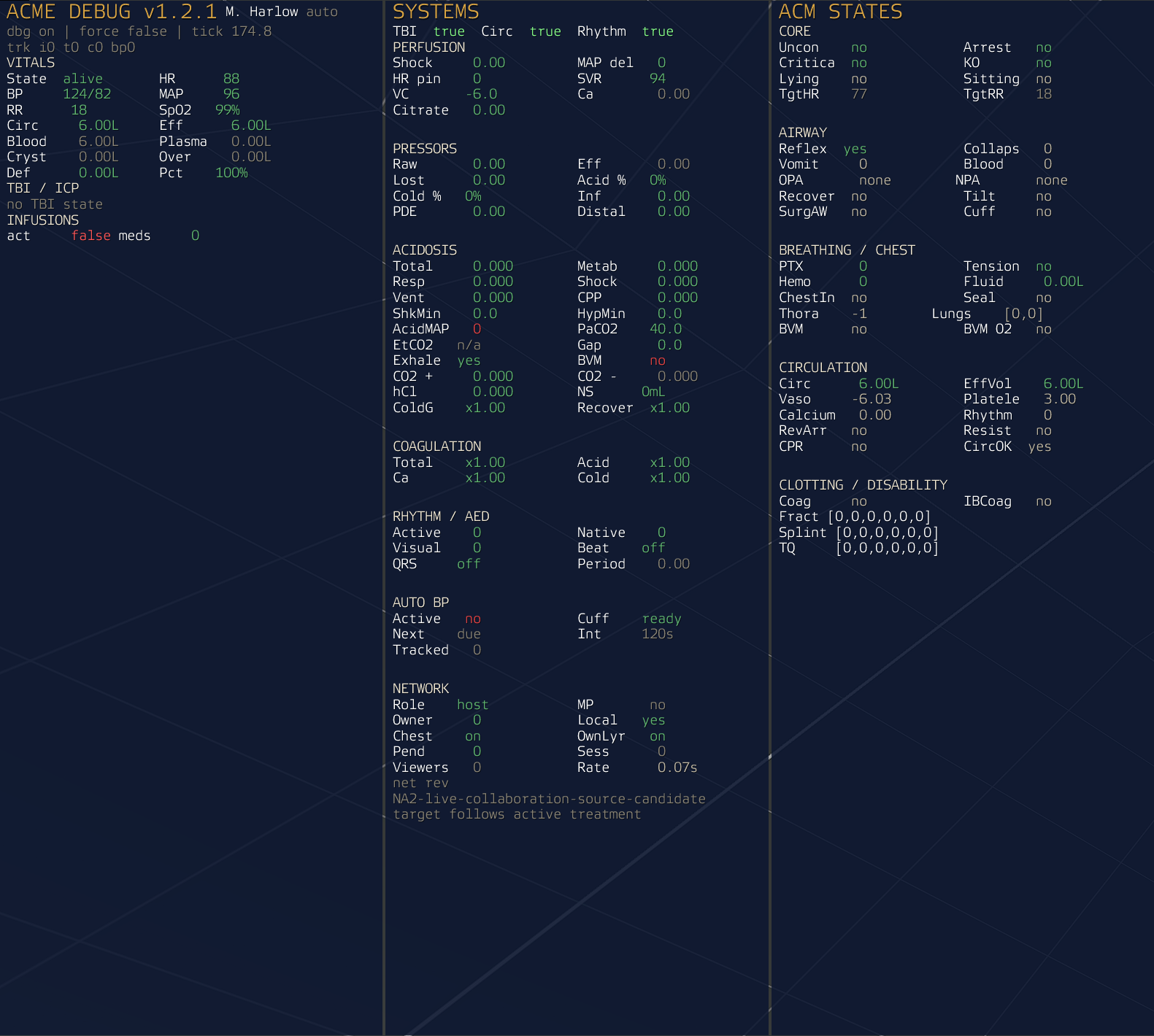
Confirm which patient and which machine you are reading before interpreting a treatment result. Tracking counts apply to the local runtime lists, not just the selected patient.
| Display field | Unit / format | Meaning and interpretation |
|---|---|---|
CLINICAL 1/2 / NETWORK 2/2 | Current page | Clinical overview or network/engineering detail. Use Ctrl + Page Up / Page Down to change pages and capture both when a report needs patient state and ownership information. |
Build batch | Revision label | Shown beside the patient name in the current clinical header. Include it with the mod version: a version string alone may span more than one TBI implementation. |
ACME DEBUG v1.2.1 | Version | Version read from the loaded ACM Extended configuration, with a runtime fallback. Include this in a bug report; the screenshot records v1.2.1. |
M. Harlow | Patient name | The selected debug target in the example. An explicit debug target takes precedence, followed by the last treatment target; automatic fallback searches tracked patients and then the player. |
auto / treating | Target mode | treating appears when the chosen patient is the last treatment target. auto covers the other selection paths; it does not mean an automated treatment is running. |
dbg on | Overlay status | The debug display passed its enable gate. This does not turn every optional simulation system on. |
force false | Boolean | Whether the emergency force overlay flag is set. false is normal when the regular debug option enabled the display. |
tick 174.8 | Engine seconds | Engine diagnostic clock at rendering time. It is not injury duration, network latency or patient age. |
trk i0 | Count | Patients in the infusion tracking list on this machine. |
trk t0 | Count | Patients in the TBI tracking list on this machine. |
trk c0 | Count | Patients in the Extended circulation tracking list on this machine. |
trk bp0 | Count | Patients in the automatic blood pressure tracking list on this machine. |
target follows active treatment | Reminder | Recheck the patient name after switching patients. This footer describes the normal treatment target behavior. |
These are stored patient values and calculated diagnostics. The debug SpO₂ reads the underlying oxygen variable directly, so it can differ from what a peripheral pulse oximeter can reliably show in game.
| Display field | Unit / format | Meaning and interpretation |
|---|---|---|
State | alive / dead | Engine life state. An alive patient can still be unconscious, critically ill or in cardiac arrest. |
HR | Beats/min | Rounded stored heart rate. This is distinct from the rhythm code and from the target heart rate. |
BP | Systolic / diastolic, mmHg | Blood pressure getter result, displayed as systolic over diastolic. |
MAP | mmHg | Mean arterial pressure, calculated as (systolic + 2 × diastolic) ÷ 3 when a systolic result is available; otherwise the stored MAP is used. |
RR | Breaths/min | Stored respiration rate. A rate alone does not establish that enough air reaches the lungs. |
SpO2 | % | Rounded internal ace_medical_spo2 value. This is not a guarantee of a valid pulse ox probe signal, adequate blood volume or adequate oxygen delivery. |
Circ | L | Immediately circulating volume returned through ACE, with an Extended circulating volume fallback. It includes retained fluid; it is not just the Blood compartment. |
Eff | L | ACM weighted effective volume: Blood + 0.3 × Plasma − Overload, limited between zero and the normal volume reference. Crystalloid has no direct term in this particular calculation. |
Blood | L | Retained blood compartment. Transfusion and gradual conversion from other compartments can change it. |
Plasma | L | Retained plasma compartment. It can contribute to circulating volume before its gradual conversion into the blood compartment. |
Cryst | L | Retained saline/crystalloid compartment, including compatible carriers classified into that compartment. |
Over | L | Recorded overload compartment. This is separate from the volume administered from a bag. |
Def | L | Circulating volume deficit: max(normal reference − Circ, 0). It is not normal reference − Blood. |
Pct | % | Circ ÷ normal volume reference × 100, rounded. The usual reference is 6 L. |
Here all retained volume is in Blood, so Circ and Eff match. They can separate after resuscitation. See Fluids & blood volume and Oxygen delivery for those distinctions.
The current NEURO / TBI block separates lasting injury, active burden and the two control systems. Read its trend alongside blood volume, oxygen delivery and breathing. A normal saturation alone does not establish that the brain receives enough oxygen.
| Display field | Unit / format | Meaning and interpretation |
|---|---|---|
Acute | 0–1 score | , stored as severity. It can fall toward zero when pressure, oxygen delivery and ventilation are adequate. Past herniation can impose a recovery floor. |
Struct | 0–1 score | , stored as structuralSeverity. This controls remaining reserve and severity based pressure requirements. A resolved concussion can retain Struct while Acute resolves; Struct alone no longer keeps producing raised ICP or unconsciousness. |
ICP | mmHg, rounded | Current modeled pressure inside the skull. During recovery it approaches the normal baseline, usually 10 mmHg, rather than zero. Zero can be an empty-state fallback in this renderer. |
CPP | mmHg, rounded | This clinical display calculates systemic MAP − ICP. The treatment handler uses effective brain MAP − ICP: head elevation subtracts 6 mmHg from MAP by default. The displayed CPP can therefore be 6 mmHg higher than the value used by the recovery gate. |
Autoreg | Integrity, 0.05–1 after initialization | : how well the brain regulates its own blood flow as pressure changes. Lower integrity increases vulnerability to low CPP and makes high CPP more pressure passive, so excessive pressure can add to ICP. This is separate from systemic autonomic control. |
Auto | Integrity / signed tone | First value: , bounded to 0.05–1 after initialization. Second: . Positive means a tightening influence on vessels, near zero means neutral TBI tone, and negative means a dilating influence. The renderer does not print a plus sign on positive values. |
Hern | yes / no | The herniating state flag. It is not the numbered stage or the maximum stage reached; use the fuller state dump for progression, accumulated exposure and recovery floor. |
Cushing | yes / no | Raised ICP has reached the Cushing trigger, normally 25 mmHg. The flag alone does not tell you whether vascular reserve remains intact. Autonomic failure can affect resistance without the full Cushing pulse and breathing pattern. |
Obtund | yes / no | The patient’s flag. It is distinct from unconsciousness and is not a direct measure of structural injury. |
PerfOK | yes / no | The TBI pressure gate: effective MAP meets the structural grade’s recovery minimum, ICP is at most 25, and any grade specific CPP floor is met. Severe injury adds CPP ≥55; critical adds CPP ≥60 mmHg; mild/moderate do not get that added high CPP requirement. Oxygen delivery, saturation and ventilation must also pass before acute burden can resolve. |
The compact CPP display still uses fixed colours: below 50 red, 50 to below 70 amber, and 70 or above green. Those colours do not encode the new structural grade or head elevation adjustment. PerfOK yes with an amber CPP can be consistent with recovery. Mild/moderate injury is no longer universally harmed below MAP 85; see the head injury pressure and recovery guide for the actual thresholds. PerfOK defaults to yes if the state is missing.
Auto 0.82 / 0.64
Positive tone supports vessel tightening. It can raise peripheral resistance and reduce the custom junctional bleeding channel. This is a controller example, not a guarantee of adequate blood flow.
Integrity falls; tone swings.
The output becomes less reliable. Compare successive Auto readings with SVR, MAP, bleeding and PerfOK instead of treating a single high pressure as recovery.
Auto 0.30 / -0.70
Negative tone favours vasodilation. Falling systemic resistance and weaker local vessel compensation can allow junctional hemorrhage to accelerate.
Vascular failure can precede the full vital sign pattern. The resistance only path changes systemic vascular resistance without forcing Cushing bradycardia, abnormal respirations or a hypertensive target. It is not a separate electrical rhythm diagnosis. During established cardiac arrest, the TBI vital sign writer releases its outputs to the arrest system; the TBI state continues to update.
Junctional vessel compensation reads integrity as 0.25 + 0.75 × integrity of its normal ability. The formula spans 25% at zero to 100% at one; the current TBI controller’s 0.05 lower bound gives 28.75% at that bound. Signed tone is already carried through systemic resistance and is not multiplied into the junctional equation a second time.
These rows preserve the earlier screenshot renderer’s labels and conditional infusion records. They are not all rows in the new compact NEURO / TBI block.
| Display field | Unit / format | Meaning and interpretation |
|---|---|---|
no TBI state | Status text | Earlier explicit empty TBI state message. It is not a measured ICP of zero and does not describe every possible cause of unconsciousness; the current compact block instead uses fallback values. |
ICP | mmHg | Modeled intracranial pressure when a TBI state exists. |
CPP | Current / target, mmHg | Earlier current/target presentation, using displayed MAP − ICP. The target (normally 70) is a reference, not a universal recovery gate. The current clinical block shows a single CPP value; the treatment handler also accounts for effective brain MAP. |
sev | 0–1 score | Earlier single severity label. In the current state, severity is the active burden shown as Acute; the lasting injury record is shown separately as Struct. Neither is a Glasgow Coma Scale score. |
cush | Boolean | The modeled Cushing response is active at the current ICP threshold. |
hern | Boolean | The modeled herniation process is currently active. Interpret with stage and gate. |
stage | Model stage | 0 is no progressed stage; 1, 2 and 3 are progressively more severe herniation stages. The value can be fractional during recovery. |
gate | Boolean | The required sustained high ICP exposure has reached the herniation gate. It is a progression condition, not an airway gate. |
remain | Seconds | Time still required to fill that high ICP gate at its current accumulated exposure. This is not the remaining lifetime or the stage change countdown. |
Na | mEq/L, modeled | Rounded sodium concentration in the TBI state, used by osmotherapy limits. The overlay omits the unit. It is not the administered HTS volume. |
act | Boolean | The selected patient has the bag medication tracking flag. false means that flag is off; it does not mean all previously delivered medications have stopped working. |
meds | Entry count | Number of medication components in the bag medication tracking array. This is neither the number of all drugs on board nor necessarily the number of physical bags. |
Raw infusion rows | Up to 5 arrays | When present, these are internal tracker records containing bag/site identity, medication, remaining drug, volume and flow bookkeeping. The total count can exceed the five displayed rows. Use the medication and transfusion interfaces for readable dosing information. |
System switches indicate whether a model is enabled. They do not mean the patient has TBI, shock or an arrhythmia. Perfusion rows combine current patient variables with diagnostic mirrors.
| Display field | Unit / format | Meaning and interpretation |
|---|---|---|
SYSTEMS: TBI | Boolean | Extended TBI system enabled for the mission. In the screenshot it is true even though the selected patient has no TBI state. |
SYSTEMS: Circ | Boolean | Extended circulation model enabled. |
SYSTEMS: Rhythm | Boolean | Extended rhythm system enabled. |
Shock | 0–1 severity mirror | Diagnostic shock severity variable. It is intended to describe the Extended shock process, not the amount of blood lost. A zero/default mirror does not exclude hypovolemic shock. |
MAP del / MAP delta | mmHg equivalent estimate | Net modeled support minus shock and calcium related pressure penalties. The narrow renderer truncates the label to MAP del. This is a diagnostic estimate; the current model carries effects through heart rate and vascular resistance rather than adding this value to BP a second time. |
HR pin | Beats/min or 0 | Rhythm controlled heart rate pin. Zero means no positive pin is shown, not no heartbeat. |
SVR | Engine resistance units | Stored peripheral vascular resistance. The nominal scale is around 100; these are game units, not a measured clinical SVR in dyn·s/cm⁵. |
VC | Game tone value | ACM vasoconstriction state, also shown as Vaso in ACM States. Negative values can occur at baseline or with a dilating influence; read the resulting BP and perfusion alongside it. |
Ca | Legacy diagnostic credit | Reads the calcium credit mirror, defaulting to zero. It is not the serum calcium level or the current ionized calcium fraction used by the circulation model. |
Citrate | Legacy diagnostic load | Reads the citrate load mirror, defaulting to zero. The current calcium model also uses transfused blood volume and calcium replacement, so a zero here alone cannot rule out a transfusion related calcium deficit. |
Raw, Eff and Lost show the model’s estimated pressure support response. Compare support with the actual BP trend. Acidosis and cold can reduce the response even while medication is reaching the patient.
| Display field | Unit / format | Meaning and interpretation |
|---|---|---|
Raw | mmHg equivalent support | Combined modeled infusion, bolus and surge support before the acidosis and cold reductions. Earlier delivery, volume and calcium gates may already have affected this number. |
Eff | mmHg equivalent support | Support remaining after the acidosis and cold reductions. This is not a fluid volume. |
Lost | mmHg equivalent support | max(Raw − Eff, 0). It measures modeled loss of response, not leaked drug mass. |
Acid % | % reduction | Acidosis related support reduction. It is not blood pH, the total acidosis score or the percentage of the dose lost. |
Cold % | % reduction | Hypothermia related support reduction. Acid and Cold multiply their remaining fractions; simply adding their percentages overstates the combined loss. |
Inf | Diagnostic support mirror | The public infusion support mirror read by this overlay. The current detailed support is stored in the circulation state; a default zero in this mirror is not proof that no infusion is active. |
PDE | Diagnostic support mirror | Push dose epinephrine support mirror. PDE here means push dose epinephrine, not a phosphodiesterase medication. The current bolus support calculation is tracked separately in circulation state. |
Distal | Legacy surge mirror | Former distal site pressor spike diagnostic. The current circulation calculation explicitly sets the location only spike to zero. A distal IV does not itself turn norepinephrine into epinephrine; local leakage and vesicant injury remain separate concerns. |
Effective support = Raw × (1 − Acid fraction) × (1 − Cold fraction). For example, Raw 20 with Acid 25% and Cold 20% gives 20 × 0.75 × 0.80 = 12, with 8 lost. These are diagnostic support units, not a dosing recommendation.
The acidosis scores are internal 0–1 burdens, not pH values. The rows explain whether poor perfusion, inadequate ventilation, saline exposure or low CPP is feeding that burden.
| Display field | Unit / format | Meaning and interpretation |
|---|---|---|
Total | 0–1 score | Combined metabolic and respiratory acidosis, capped at 1. Used by response and coagulation effects. |
Metab | 0–1 score | Metabolic acidosis burden, including the saline related floor in the current model. |
Resp | 0–1 score | Respiratory acidosis burden responding to retained arterial CO₂. |
Shock | 0–1 driver | Current poor perfusion fraction driving metabolic acidosis. This is different from the shock severity mirror under Perfusion. |
Vent | 0–1 deficit | Modeled ventilation deficit. A value of zero means no deficit in this calculation, not that the ventilator is off. |
CPP | 0–1 driver | Contribution from inadequate cerebral perfusion to the acidosis model. This is not the mmHg CPP shown under TBI / ICP. |
ShkMin | Minutes | Accumulated time in inadequate perfusion used by the onset model. It helps explain why a newly low pressure may precede a large metabolic burden. |
HypMin | Minutes | Hypoventilation dwell time used by CO₂ retention. It is not hypovolemia time or hypothermia duration. |
AcidMAP | mmHg | The pressure estimate fed into the acidosis driver, before the final support reductions. Arrest can force its base to zero. An absent circulation state also defaults this field to zero. |
PaCO2 | mmHg | Modeled arterial CO₂. The usual initial value is 40.0, including the fallback used before a state is available. |
EtCO2 | mmHg or n/a | Observed end-tidal CO₂ from the common game getter when available. n/a means the overlay has no observed value; it does not mean a measured zero. |
Gap | mmHg | Nonnegative arterial minus end-tidal CO₂ gap. If no observed EtCO₂ exists, the model can use its estimate for the gap. Read this with EtCO2 availability. |
Exhale | yes / no | Whether the model detects sufficient exhalation conditions. It is not the instantaneous inspiration/expiration phase of a waveform. |
BVM | yes / no | Whether the acidosis model detects active manual ventilation. no is expected for an independently breathing patient; the red text alone does not mean treatment is required. |
CO2 + | mmHg/s | Current modeled rate of PaCO₂ accumulation from inadequate ventilation. |
CO2 − | mmHg/s | Current modeled PaCO₂-clearance rate. It is limited by the model’s normal PaCO₂ floor, so a positive rate does not guarantee the stored value is falling below normal. |
hCl | 0–1 score | Hyperchloremic acidosis burden from the tracked normal saline exposure. It is not hydrogen chloride concentration or a measured serum chloride. |
NS | mL | Tracked normal saline exposure used by that model. This is not total bag volume or the amount currently in the crystalloid compartment. |
ColdG | Multiplier | Cold related multiplier on metabolic acidosis accumulation. ×1 is baseline; higher values accelerate accumulation. |
Recover | Multiplier | Cold related multiplier on metabolic acidosis recovery. ×1 is baseline; lower values slow recovery. |
The same screenshot shows BP 124/82 and MAP 96, while AcidMAP is 0 and the circulation tracker is empty. AcidMAP has a zero fallback when its state has not been populated. Read the displayed patient BP first; this isolated zero does not establish absent perfusion.
These multipliers represent worsening bleeding associated with impaired coagulation. Higher numbers are penalties, not stronger clot formation.
| Display field | Unit / format | Meaning and interpretation |
|---|---|---|
Total | Multiplier | Combined calcium × cold × acidosis multiplier used by the bleeding model. ×1.00 is baseline. |
Acid | Multiplier | Acidosis contribution to the coagulation penalty. |
Ca | Multiplier | Calcium deficit contribution to the coagulation penalty. This is distinct from Perfusion Ca and ACM States Calcium. |
Cold | Multiplier | Hypothermia contribution to the coagulation penalty. |
NS tick | Source label, conditional | Last normal saline tracking source, shown only after one is recorded. |
At | Mission seconds, conditional | Timestamp associated with that last saline tracking event. |
Rhythm codes identify the electrical pattern or its internal representation. A code is not a heart rate, and electrical activity alone does not establish a pulse.
| Display field | Unit / format | Meaning and interpretation |
|---|---|---|
Active | Extended rhythm code | Selected Extended custom rhythm. Zero means no custom override is shown; inspect Native as well. |
Native | ACM rhythm code | Native ACM cardiac rhythm state. A custom rhythm may use a native proxy for the underlying game state machine. |
Visual | Display rhythm code | AED visual rhythm cache. It can differ from the underlying rhythm during artifact or display handling; a default zero does not prove a monitor is attached. |
Beat | on / off | Legacy beat clock feature flag. off does not mean the patient has no heartbeat. |
QRS | on / off | Legacy QRS/beep lock feature flag. off does not mean there are no QRS complexes. |
Period | Seconds | Stored AED beat period. A zero/default means no positive period is stored here, not necessarily asystole. |
| Display field | Unit / format | Meaning and interpretation |
|---|---|---|
−5 / −1 | Native codes | −5: unavailable rhythm representation. −1: CPR artifact representation. |
0 | Native code | Sinus representation. Rate and perfusion still need separate assessment. |
1 / 2 | Native codes | 1: asystole. 2: ventricular fibrillation. |
3 / 4 / 5 | Native codes | 3: ACM PVT, the pulseless ventricular tachycardia representation. 4: ventricular tachycardia. 5: pulseless electrical activity. |
100 / 101 | Extended codes | 100: atrial fibrillation with rapid ventricular response. 101: atrial tachycardia. |
102 | Extended code | Torsades de pointes. Uses native PVT code 3 as its underlying proxy. |
103 / 104 | Extended codes | 103: controlled rate atrial fibrillation. 104: supraventricular tachycardia. |
The automatic BP block describes the selected patient’s cuff task and the machine’s tracking list. A scheduled reading can still depend on a usable monitor and cuff.
| Display field | Unit / format | Meaning and interpretation |
|---|---|---|
Active | yes / no | Automatic BP cycling is enabled for this patient. |
Cuff | busy / ready | Whether the pressure cuff is currently occupied with a reading. Ready describes its busy flag; it is not confirmation that all placement requirements are met. |
Next | Seconds / due | Countdown to the stored next read time. due is also shown when no positive time exists; with Active no it does not mean an unattended overdue measurement. |
Int | Seconds | Configured interval between automatic BP cycles. The screenshot shows 120 s. |
Tracked | Count | Patients in the automatic BP tracking list on this machine, repeating the header bp count. |
These fields describe the machine rendering the overlay and the chest treatment synchronization layer. They are useful when a treatment appears locally but is not accepted by the patient’s simulation owner.
| Display field | Unit / format | Meaning and interpretation |
|---|---|---|
Role | host / client / dedi | This machine’s role. host is a server that is not dedicated; it can also appear in singleplayer. dedi is a dedicated server. |
MP | yes / no | Whether the mission is multiplayer. Read it beside Role; the screenshot’s host and MP no are compatible. |
Owner | Machine ID | Engine owner identifier for the selected patient. It is not a Steam ID or player count. |
Local | yes / no | Whether this patient is local to this machine. Local yes means its owner side simulation is here. Local no can be entirely normal in multiplayer. |
Chest | on / off | Chest networking layer initialized on this machine. On does not prove another machine received a request. |
OwnLyr | on / off | Patient owner routing layer initialized here. Again, initialization is not a round trip delivery test. |
Pend | Count | Outstanding chest seal edit requests on this machine. This is machine wide chest bookkeeping, not every treatment or only the displayed patient. A count that persists without clearing suggests unacknowledged requests. |
Sess | Count / n/a | Chest edit sessions on the server. Clients show n/a because the server owns the session map; this is not the number of people on the server. |
Viewers | Count | Remote recipients in the local live gesture presence list, excluding the local viewer. Zero is normal when nobody else is receiving that stream. |
Rate | Seconds | Configured gesture send interval. 0.07 s is approximately 14 sends per second. It is not measured ping, packet loss or bandwidth; a larger interval sends less often. |
net rev | Revision string | Networking build marker. In the screenshot it is NA2-live-collaboration-source-candidate. Include the full text when reporting synchronization issues. |
The right column exposes underlying flags and item slots. Position flags are treatment states rather than a complete description of the unit’s visible animation.
| Display field | Unit / format | Meaning and interpretation |
|---|---|---|
Uncon | yes / no | ACE unconscious state. |
Arrest | yes / no | ACE cardiac arrest state. This is separate from alive/dead and from the displayed electrical rhythm. |
Critica / Critical | yes / no | ACM critical vitals state. The seven character label column clips Critical to Critica in the screenshot. |
KO | yes / no | ACM knockout state. It is a separate flag from ACE unconsciousness. |
Lying | yes / no | ACM lying position state. |
Sitting | yes / no | ACM sitting position state. |
TgtHR | Beats/min | Target toward which the heart rate system is being driven. It need not match the current HR while other influences or easing are active. |
TgtRR | Breaths/min | Target respiration rate, distinct from the current RR. |
| Display field | Unit / format | Meaning and interpretation |
|---|---|---|
Reflex | yes / no | Airway reflex flag. A protective reflex being present is separate from the amount of obstruction. |
Collaps / Collapse | 0–3 state | Airway collapse severity: 0 none, 1 mild, 2 moderate, 3 severe. The label can be clipped. Adjuncts and position can change effective patency without making every raw state disappear. |
Vomit | Obstruction state | Vomit obstruction burden. Zero means no recorded vomit obstruction; positive values are not milliliters. |
Blood | Obstruction state | Blood obstruction burden in the airway. This is unrelated to the Blood volume in Vitals. |
OPA | Item label / none | Oral airway slot. The label is abbreviated OPA, but the stored item can be OPA or SGA. None means the slot is empty. |
NPA | Item label / none | Nasal airway slot. |
Recover | yes / no | Recovery position state. This is not the acidosis recovery multiplier. |
Tilt | yes / no | Head tilt airway position state. |
SurgAW | yes / no | Surgical airway state. It is not the endotracheal tube flag. |
Cuff | yes / no | Surgical airway cuff inflation flag. It does not report ETT cuff status or a BP cuff. |
Read injury state, fluid quantity and treatment flags together. A procedure flag alone does not describe residual pleural injury or actual ventilation.
| Display field | Unit / format | Meaning and interpretation |
|---|---|---|
PTX | Native projected state, 0–4 | Pneumothorax state projected from the current pleural model. Zero is no projected pneumothorax. The underlying model can contain more detail than this capped display value. |
Tension | yes / no | Tension pneumothorax flag. Interpret alongside PTX and the patient’s pressure and breathing. |
Hemo | Severity state | Hemothorax state. This is a severity indicator; the actual pleural blood volume appears in Fluid. |
Fluid | L | Blood accumulated in the hemothorax model, not circulating fluid volume. |
ChestIn / ChestInj | yes / no | Chest injury flag. Its label is clipped in the screenshot. |
Seal | yes / no | Native chest seal flag. It is not a count or a complete per wound map of the chest seal minigame. |
Thora | Procedure state | −1 is the renderer’s unset fallback; 0 is closed, 1 is an open thoracostomy and 2 is a chest tube placed. State 3 is the legacy tube reseal/failure state. Current tube placement no longer creates delayed failure solely from posture. |
Lungs | Two sound state codes | State per stethoscope side: 0 normal, 1 shallow, 2 dull, 3 crackles. The current listening code reads index 0 for its right side control and index 1 for its left side control. Live edema logic can add crackles when a stored side still reads 0. |
BVM | yes / no | Stored BVM use flag. Compare with the acidosis model’s BVM detection and actual breaths. |
BVM O2 | yes / no | Whether oxygen is connected to the BVM. It does not describe oxygen supplied by every other device. |
Some right column values repeat the left column. Others are native game bookkeeping that should not be read as laboratory measurements.
| Display field | Unit / format | Meaning and interpretation |
|---|---|---|
Circ | L | Same circulating volume value as Vitals Circ. |
EffVol | L | Same weighted effective volume value as Vitals Eff. |
Vaso | Game tone value | Same vasoconstriction state as Perfusion VC, with two decimal places here. |
Platele / Platelet | Game count | Native platelet count resource, usually initialized to 3. It is not a platelet laboratory concentration. The label is clipped in the screenshot. |
Calcium | Game count | Native calcium count resource. It differs from the calcium credit mirror, modeled serum calcium and the coagulation multiplier. |
Rhythm | Native rhythm code | Same native rhythm state described under Rhythm / AED. |
RevArr | yes / no | Native reversible cardiac arrest state flag. It describes a state machine condition, not a guarantee of ROSC. |
Resist | yes / no | Cardiac arrest shock resistance flag. This means resistance to defibrillation in the game, not systemic vascular resistance. |
CPR | yes / no | The raw isPerformingCPR flag on the selected object. It reports that stored role flag; confirm who is provider and who is patient before reading it as compressions received. |
CircOK | yes / no | ACM circulation state flag. This is not a complete stability score. |
| Display field | Unit / format | Meaning and interpretation |
|---|---|---|
Coag | yes / no | Native external wound coagulation handler active. No does not mean the patient is unable to clot. |
IBCoag | yes / no | Native internal bleeding coagulation handler active. No does not by itself diagnose coagulopathy. |
Fract | Six entry state array | Fracture states by body part: 0 none, 1 mild, 2 severe, 3 complex. The order is head, torso, left arm, right arm, left leg, right leg. |
Splint | Six entry native array | The ACE splint array, in the same body part order. A zero/default means that native slot is clear. This overlay does not show every Extended splint status variable. |
TQ | Six entry clock label array | Tourniquet application time labels in the same order. Recorded entries use the in game HH:MM clock; zero is the empty default. These are not elapsed minutes, tourniquet counts or necrosis scores. |
The healthy screenshot does not show these sections. Their conditional appearance helps distinguish an accepted medication, developing effect and active support.
| Display field | Unit / format | Meaning and interpretation |
|---|---|---|
SEDATED | Status text | Reports the sedation latch or whether the combined induction normalized load has reached 1.0. It can show below induction or induction threshold before the latch changes. |
Ketamine | Induction multiple / pending | Ketamine’s normalized hypnotic contribution. Accepted, onset pending means a raw admitted medication record exists before its effective curve rises. |
Propofol | Normalized load | Propofol hypnotic contribution to the shared sedation calculation. |
Sed total | Normalized load | Combined hypnotic result with configured synergy and opioid adjuncts. A value of 1 is the configured induction threshold. |
Fentanyl | Attenuation % / adjunct multiplier | Effective fentanyl attenuation and its contribution to the hypnotic calculation. The percentage is not a serum concentration. |
SUGAMMADEX | mg/kg, onset %, rev | Modeled body weight dose, onset progress and effective rocuronium reversal. Rev is an effect value, not a volume. |
MIDAZ | Onset % | Midazolam sedation onset progress. Delivery and full sedation effect are separate events. |
PARALYZED | Status text | Rocuronium block state, with onset, accepted pending and sub dose states. YES – AWAKE identifies awake paralysis; YES (apnea, ventilate) identifies active block with support required. |
AWARENESS | Event / seconds | Latched awareness event and accumulated aware time. Later sedation does not clear the already recorded event. |
VENT | Status / rate × setting / MV % | Off, intubated but not connected, or driving. The compact driving line shows configured rate and volume setting plus minute ventilation adequacy. Check measured VTi/VTe in the detailed ventilator block. |
| Display field | Unit / format | Meaning and interpretation |
|---|---|---|
LIDOCAINE: Serum / Band | mcg/mL / category | Modeled accumulated lidocaine concentration and highest reached toxicity band. The label describes the model’s band, not a real laboratory result. |
Seizure | none / active / postictal | Lidocaine seizure phase. |
Benzo | Effective / required | Effective benzodiazepine load compared with the modeled requirement, which can rise with lidocaine toxicity. |
ESMOLOL: Drip / Serum / Band | mg/min / mcg/mL / category | Delivered rate drive, modeled concentration and effect band. |
ESMOLOL: Overdose / Effects | % / text | Modeled toxic blockade fraction and the associated bradycardia/hypotension description. |
INFUSION RATE: Amio / Mag | mg/min | Admitted amiodarone and magnesium delivery rates when large enough to display. |
Fast push | % penalty | Highest fast delivery penalty for those displayed drugs. It is not the fraction of a syringe already pushed. |
CALCIUM heading | Salt label | CaCl₂, gluconate, both, or washing out. The last state means the modeled effect remains after an active salt infusion is no longer identified. |
CALCIUM: Serum | Current / upper reference, mg/dL | Modeled supplemental calcium serum level and configured high reference. It is not the patient’s full measured serum calcium. |
CALCIUM: Rate | Salt mg/min, elemental mg/min | Salt delivery rate with its elemental calcium rate in parentheses. The two salts contain different elemental fractions. |
CALCIUM: Band / Overdose | Effect category / % | Modeled overdose severity and current consequence band. |
AMIODARONE: Serum / Rate / Band | mg/L / mg/min / category | Modeled concentration, admitted delivery rate and effect band. |
Cumulative | Current / ceiling, mg | Cumulative amiodarone compared with its configured QT/torsades ceiling. This is separate from the current concentration. |
Fast infusion | % penalty | Amiodarone’s current fast infusion penalty. |
SERUM LEVELS | Drug specific units | Other supported pharmacokinetic models appear by drug name with their configured unit. Read the unit on each row; these values are not interchangeable with normalized medication effect loads. |
| Display field | Unit / format | Meaning and interpretation |
|---|---|---|
BLAST LUNG: Sev | 0–1 score | Modeled blast lung injury severity. |
BLAST LUNG: Vent | ok / NO | This display check requires a driving ventilator, minute ventilation adequacy above 0.6 and FiO₂ at least 50%. It is a specific display condition, not a complete ventilation assessment. |
VENTILATOR heading | Mode label | Current ventilator mode while the ventilator is driving the patient. |
PIP | cmH₂O | Modeled peak inspiratory pressure, colored by its pressure state classification. |
Comp | Relative compliance | Lung compliance factor, with 1 near the model’s baseline. This is not an absolute mL/cmH₂O measurement. |
VTi / VTe | mL | Inspired and expired tidal volumes. Compare them with the setting and actual delivered ventilation. |
VILI | Injury score | Accumulated modeled ventilator related lung injury burden. |
Baro | Event count | Recorded barotrauma events. |
CBRN: Exposed / Contam | yes / no | Chemical exposure and contamination state flags. This block appears when relevant flags or injury values are present. |
CBRN: Airway / Lung | Game injury scales | Airway inflammation and lung tissue damage values. They are not doses or percentages unless a particular system explicitly defines them that way. |
Compare a short sequence of observations. A single screenshot may show defaults, a pending onset or values that update on different simulation ticks.
| Display field | Unit / format | Meaning and interpretation |
|---|---|---|
Drug accepted, little immediate effect | Check onset | Look for accepted/pending, effective sedation or serum progression, bag flow and the patient’s actual response. Bag medication count does not include every injected drug. |
Good SpO₂, unstable patient | Check delivery and perfusion | Compare BP, Circ, Blood, breathing and player assessments. Debug oxygen saturation does not replace a reliable probe signal or prove adequate oxygen delivery. |
Struct remains after symptoms improve | Compare Acute and ICP | A retained injury history is expected. Acute should fall under suitable recovery conditions and ICP should approach its normal baseline; a nonzero Struct alone is not evidence of ongoing deterioration. |
PerfOK yes, Acute not improving | Check the other recovery gates | Check tissue oxygen delivery, the delivery deficit latch, saturation, ventilation and any herniation recovery floor. PerfOK reports pressure conditions, not all requirements for recovery. |
TBI plus accelerating junctional bleeding | Compare vascular control | Record Auto integrity/tone, Autoreg, SVR, MAP, blood volume and bleeding over time. A negative tone and falling integrity can remove earlier vascular compensation without a fixed TBI bleeding multiplier. |
Treatment visible only to one player | Check ownership | Capture patient name, Owner, Local, Role, MP and net rev on both machines; note whether Pend remains nonzero. |
Different HR and monitor behavior | Check representations | Capture current HR, TgtHR, Native, Active and Visual together. Beat/QRS off are feature flags, not diagnoses. |
Zero AcidMAP despite normal vitals | Check active state | Look at the circulation tracker and whether the model has populated its state. Do not interpret an isolated default as a measured pressure. |
Unexpected value or clipped label | Keep the full context | Record the mod version, active settings, exact action, elapsed time and screenshots of both current pages (or all columns on an earlier build). The debug-to-clipboard dump contains the fuller raw state for a technical report. |
Current TBI fields and meanings were checked against B119, dev revision 98d18bb, on 14 September 2026. This is the TBI update; main was still at 5416332 when checked. The supplied screenshot and the earlier field reference were checked at 21f8694; the image remains unchanged. The runtime patch has source/model checks, while in-engine physiology and multiplayer behavior still need staging validation.