Assess the airway, chest, breathing and circulation. Connect the patient and confirm effective ventilation.
Select the mode and patient weight. Check rate, volume or pressure target, FiO2, PEEP and the pressure limit.
Confirm delivered VTe, minute ventilation, respiratory rate, airway pressure and SpO2 after breaths have begun.
Reassess after every setting change, airway intervention, movement or alarm.
VolumeVTeCompare delivered volume with the target
VentilationMV + EtCO2Check air movement and the CO2 trend
PressurePIP + PEEPWatch pressure limits and trapped gas
PatientSpO2 + perfusionCheck oxygenation and circulation together
In gameWhat Simple Ventilator Mode changes
Simple Ventilator Mode keeps the selected rate with automatic supporting settings. It still models airway and lung problems, perfusion, power and circuit failures. Advanced values remain stored when simple mode is enabled.
Default settings at a glanceGame defaults
These are the current fallback settings when a stored advanced value is absent. They are separate from the injury examples below. The ventilator uses its selected weight for mL/kg calculations.
Advanced mode
SIMV VC PS
Rate
12breaths/min
VTi
500mL
FiO2
21%
PEEP
5cmH2O
I:E
1:2
Pressure support
10cmH2O
Pressure limit
40cmH2O
Weight
70kg
The advanced default pressure limit of 40 cmH2O is above the default 35 cmH2O injury threshold. A breath can stay within that limit and still accumulate pressure injury.
Simple mode: selected rate, VTi 500 mL, FiO2 95%, PEEP 5, I:E 1:2 and pressure limit 35 cmH2O. During arrest, its automatic VTi becomes 420 mL and PEEP becomes 0. Advanced CPR mode has its own defaults in the card below.
Ketamine sedation and nystagmus
What you will see
Assess Pupils can show nystagmus when deep ketamine sedation is present. With plain descriptors, the report says the eyes are rapidly and involuntarily moving. With clinical descriptors, it adds “Nystagmus.”
When nystagmus appears
The finding requires a living, unconscious patient who is not in cardiac arrest or under rocuronium paralysis. Current ketamine effect must reach the induction normalized threshold of 1 and exceed propofol plus midazolam effects combined. Analgesic ketamine alone does not meet this threshold.
CautionHow to interpret an absent finding
This is a useful in game confirmation of ketamine dominant deep sedation when present. Its absence does not establish inadequate sedation: another sedative may dominate, or paralysis may suppress this observation. Continue assessing medication effect and ventilation. Existing injury related pupil findings remain in the same report.
Mandatory rate and tidal volume target, plus support for eligible spontaneous breaths
What to monitor
Airway pressure and delivered volume. The pressure limit can reduce delivery below the target
Mode
SIMV PC
What is set
Mandatory rate and inspiratory pressure target, with pressure support for eligible spontaneous breaths
What to monitor
Delivered volume and minute ventilation as compliance changes
Mode
CPAP PS HF
What is set
Spontaneous breathing with pressure support and PEEP
What to monitor
Respiratory effort and effective ventilation. The current model provides backup mandatory breaths if the patient cannot trigger
Mode
IMV VC (CPR)
What is set
Dedicated unsynchronized CPR ventilation
What to monitor
Effective breaths during compressions; reassess mode and respiratory effort after ROSC
In gameDuring compressions
The CPR setting prevents compression related triggering from being treated as normal patient effort. Other modes can accumulate a CPR ventilation penalty during compressions. A connected ventilator still requires active assessment of the patient.
Choosing support for the injury
Choose the card that matches the lung problem, then check what the ventilator actually delivers. These are example starting points for the game, except the CPR card’s configured defaults. Reassess oxygenation, ventilation, pressure and perfusion after each change.
Healthy lung needing supportStarting point
Mode
SIMV VC PS
PEEP
5cmH2O
FiO2
21–40%
VTi target
6–8mL/kg
I:E
1:2
Why: mandatory breaths support reduced drive. A lung with little shunt needs less recruitment; extra FiO2 does not correct inadequate air movement or blood loss.
Watch: delivered VTe, minute ventilation and patient effort. A pressure limit can prevent the full VTi target from being delivered.
Pulmonary edemaRecruitable shunt
Mode when mandatory support is needed
SIMV VC PS
PEEP
10–15cmH2O
FiO2
40–60%
VTi target
6–8mL/kg
I:E
1:2–1:1.5
Why: PEEP reduces the edema related shunt by recruiting lung units. FiO2 enriches gas reaching the remaining working lung. CPAP support is another option when using the supported spontaneous breathing path.
Watch: SpO2 benefit against falling perfusion, higher PIP and reduced VTe. Treat the underlying fluid problem; PEEP does not remove the excess volume.
Blast lung / ARDSRecruitable shunt
Pressure targeted starting mode
SIMV PC
PEEP
5–8cmH2O
FiO2
60–95%
Delivered VTe
5–6mL/kg reference
I:E
1:1.5
Why: pressure targeting makes the pressure setting explicit while the injured lung’s compliance changes. Set PInsp by the resulting delivered volume; a mode label alone does not provide enough ventilation.
Watch: VTe, minute ventilation, PIP and SpO2. Healing depends on effective support, FiO2 and pressure. Pressure control is a starting choice, not an exclusive healing requirement.
PneumothoraxFixed shunt
Chest firstAssess and perform the indicated decompression
Example after effective drainage
SIMV VC PS
PEEP
5cmH2O reference
FiO2
As neededfollow SpO2
VTi target
6mL/kg
I:E
1:2
Why: pleural air compresses the lung. PEEP cannot clear that fixed shunt, and positive pressure can increase the air leak.
Watch: drainage, recurrent chest findings, pressure and perfusion. These example numbers do not make an undrained leak safe. See chest procedures.
HemothoraxFixed shunt
Two problemsPleural blood and lost circulating volume
Example with indicated drainage and support
SIMV VC PS
PEEP
5cmH2O reference
FiO2
As neededfollow SpO2
VTi target
6mL/kg
I:E
1:2
Why: PEEP does not drain pleural blood. The casualty also needs assessment of blood loss and oxygen delivery.
Watch: chest findings, SpO2, delivered volume and perfusion. Drainage and blood volume replacement solve different parts of the problem.
Active CPRConfigured defaults
Advanced CPR mode
IMV VC (CPR)
Rate
10breaths/min
VTi
6mL/kg, bounded to 300–500 mL
PEEP
0cmH2O
Triggering
Offunsynchronized breaths
Why: the dedicated mode avoids interpreting compressions as spontaneous breathing. Default rate and mL/kg can change with mission settings.
Watch: effective breaths during compressions. After ROSC, reassess the mode, effort and delivered ventilation.
Set and reassess the rate
Rate is a separate control. The injury cards do not supply a fixed rate prescription. Use the delivered minute ventilation, EtCO2 trend and patient state to reassess it.
When the casualty also has TBI
Effective ventilation and oxygen delivery help the acute injury resolve. Follow delivered breaths, EtCO₂, pulse, volume status and pressure together. Normal SpO₂ alone cannot clear a delivery deficit from hemorrhage.
Hypoventilation can raise ICP through CO₂ retention. Excessive hyperventilation can lower ICP while adding ischemic injury. PEEP and dyssynchrony between the patient and ventilator have separate mechanical ICP effects, so reassess the response after changing support. Use the TBI recovery and ventilation guide for the current game thresholds and severity dependent pressure requirements.
Oxygen requirement, drive and delivered ventilation
Pattern
Pulmonary edema
Starting reference
PEEP 10–15; VTi 6–8 mL/kg; FiO2 40–60%
Reassess
Recruitment benefit against reduced perfusion and increasing pressure
Pattern
Blast lung / ARDS
Starting reference
Pressure control reference; PEEP 5–8; delivered VTe about 5–6 mL/kg; FiO2 60–95%
Reassess
Actual volume, minute ventilation and pressure. The healing gate is based on effective support, not a mode label
Pattern
Pneumothorax
Starting reference
Assess and treat indicated pleural drainage; use controlled pressure and reassess
Reassess
Persistent air leak and loss of drainage can worsen under positive pressure
Pattern
Hemothorax
Starting reference
Assess drainage and lost circulating volume; support breathing as needed
Reassess
PEEP does not remove pleural blood; blood volume replacement is a separate task
02
Read the delivered breath
Controls and measurements
Compare inspired and expired volume
VTi goes in; VTe comes back. Compare both when checking a breath. In the game, leak reduces expired volume relative to inspired volume, and delivered minute ventilation uses the expired volumes. Check the capnography patterns alongside these readings.
Control or reading
How to use it
Control or reading
VTi target, delivered VTi and VTe
How to use it
VTi refers to inspired tidal volume. The setting is the inspiratory target; delivered VTi is the volume actually sent into the circuit, while VTe is the expired volume returning from the patient. Pressure limits can reduce inspired delivery, and a leak can reduce VTe further
Control or reading
Minute volume
How to use it
Use delivered ventilation to assess support. The display needs time to settle after connection
Control or reading
PInsp
How to use it
In the game’s pressure control formula, delivered volume depends on PInsp minus PEEP and effective compliance
Control or reading
P. SUPPORT
How to use it
Adds support to eligible spontaneous breaths
Control or reading
FiO2
How to use it
Enriches inspired gas. It cannot fully overcome the ceiling from residual shunt
Control or reading
PEEP
How to use it
Can recruit edema- or blast related shunt, but can reduce perfusion and worsen pressure related problems
Control or reading
I:E and rate
How to use it
Together determine expiratory time. More time for expiration helps clear gas trapping
Control or reading
Pressure limit
How to use it
Caps delivered pressure and can reduce volume below the set target
The diagram below illustrates pressure and flow phases. Interpret it alongside the delivered measurements. A higher pressure requirement at unchanged target volume can reflect reduced compliance; changing mode or the pressure limit also changes the trace.
Airway pressure through one ventilatory period
For the EMMA capnograph, see the implemented waveform conditions. Its CO2 waveform is a different measurement from the ventilator’s pressure trace.
Oxygenation and shunt
Recruitable and fixed shunt
Edema and blast lung create recruitable shunt. PEEP and inspiratory recruitment reduce that component. Pneumothorax and hemothorax create a fixed component that PEEP does not clear.
In gameRecruitment and overdistension
PEEP recruitment scales across 4–15 cmH2O. Above 16 cmH2O, an overdistension term grows toward its maximum at 24 cmH2O. FiO2 improves oxygenation toward the remaining shunt ceiling; it does not erase the shunt itself. At altitude, reduced ambient pressure also affects the calculation.
Recruitable component
Edema and blast lung: PEEP and inspiratory recruitment reduce the part of the shunt the game can reopen.
Fixed component
Pleural air and blood: assess decompression or drainage. Turning up PEEP does not remove these causes.
Residual oxygen ceiling
FiO2: raises oxygenation toward the remaining shunt ceiling. A saturation plateau can mean the cause still needs treatment.
Base compliance ranges from 1.0 down to 0.20 after the following injury contributions. A separate compliance multiplier, including one lung ventilation, can reduce effective compliance to 0.10.
Insult
Compliance cost
At
Insult
Blast lung
Compliance cost
up to 0.62
At
full severity
Insult
Fluid overload
Compliance cost
up to 0.45
At
1.6 L over
Insult
Ventilator induced injury
Compliance cost
up to 0.30
At
accumulated
Insult
Compliance cost
up to 0.25
At
state 3
Insult
Compliance cost
up to 0.20
At
1500 mL
Pressure needed for volume
A lower compliance means more pressure is needed to move the same target volume. The following estimate applies before auto-PEEP and pressure limiting.
A lower pressure limit can reduce the delivered volume. This is the requested pressure estimate, not a guaranteed delivered breath.
Set VTi
Comp 1.00
Comp 0.70
Comp 0.50
Comp 0.35
Comp 0.20
Set VTi
400 mL
Comp 1.00
18
Comp 0.70
22
Comp 0.50
27
Comp 0.35
35
Comp 0.20
56
Set VTi
500 mL
Comp 1.00
20
Comp 0.70
25
Comp 0.50
32
Comp 0.35
42
Comp 0.20
68
Set VTi
600 mL
Comp 1.00
22
Comp 0.70
29
Comp 0.50
37
Comp 0.35
49
Comp 0.20
80
Set VTi
700 mL
Comp 1.00
25
Comp 0.70
32
Comp 0.50
42
Comp 0.35
56
Comp 0.20
92
Pressure control response
In pressure control, the same pressure difference moves less gas as compliance falls. Raising PEEP while holding PInsp fixed also narrows that difference.
Below danger0.004 /sAccumulated dose clears; existing injury does not automatically reverse
The following times assume a constant pressure and no prior accumulated dose.
Sustained PIP
Dose rate
Time to an injury event
Sustained PIP
36
Dose rate
0.0054 /s
Time to an injury event
3.1 min
Sustained PIP
40
Dose rate
0.0078 /s
Time to an injury event
2.1 min
Sustained PIP
45
Dose rate
0.0108 /s
Time to an injury event
1.5 min
Sustained PIP
50
Dose rate
0.0138 /s
Time to an injury event
1.2 min
Sustained PIP
55 and above
Dose rate
0.0168 /s
Time to an injury event
1.0 min
After reducing pressure
Below the danger threshold, dose decays at 0.004 per second. Reducing pressure stops further accumulation; it does not automatically reverse existing injury.
Effect
Amount
Consequence
Effect
Lung injury
Amount
+0.20
Consequence
Stiffens the lung, which raises PIP, which accrues dose faster
Effect
Pneumothorax roll
Amount
55%
Consequence
A new one on a chest with no prior injury. 100% if one already exists
Effect
Pain
Amount
+0.25
Consequence
Barotrauma hurts
CautionVolume related injury
High delivered volume can add stretch injury independently of the pressure dose branch. The calculation begins above 8 mL/kg when effective compliance is below 0.80 and scales with volume and compliance deficit. Reassess volume, pressure, obstruction and drainage together.
Gas trapping
Accumulation and clearance
The game compares expiratory time with an emptying time estimate of 1.8 seconds × effective compliance. Insufficient expiration accumulates auto-PEEP at up to 0.9 cmH2O per second. Adequate expiration clears it at 1.2 cmH2O per second.
CautionAlarm and response
The default auto-PEEP ceiling is 20 cmH2O and the GAS TRAPPING alarm threshold is 4 cmH2O. Auto-PEEP adds to pressure and can affect pressure limiting. Increase the expiratory share of I:E, lower rate when appropriate, and recheck delivered ventilation.
04
Device operation
Battery and vehicle power
Air, oxygen and power
The turbine uses ambient air to ventilate; supplemental oxygen enriches the gas mixture. When battery drain is enabled, electrical charge limits operation.
Settings
Load
Runtime
Settings
PEEP 5, RR 12, PIP 20
Load
1.02x
Runtime
54 min
Settings
PEEP 10, RR 18, PIP 30
Load
1.39x
Runtime
40 min
Settings
PEEP 15, RR 24, PIP 40
Load
1.82x
Runtime
30 min
Settings
PEEP 20, RR 35, PIP 50
Load
2.46x
Runtime
22 min
Low battery25%Plan power or battery exchange
Critical battery10%Prepare an immediate support backup
Empty battery0%Ventilation stops
Battery exchange6 secondsOffered below 90% charge
Battery limits and exchange
Default nominal battery capacity is 55 minutes.
A vehicle with its engine running supplies power and recharges an empty battery over approximately 90 minutes.
LOW BATTERY appears at 25% and BATTERY CRITICAL at 10%. At zero, ventilation stops and manual support is required.
Battery exchange takes about 6 seconds and is offered below 90% charge.
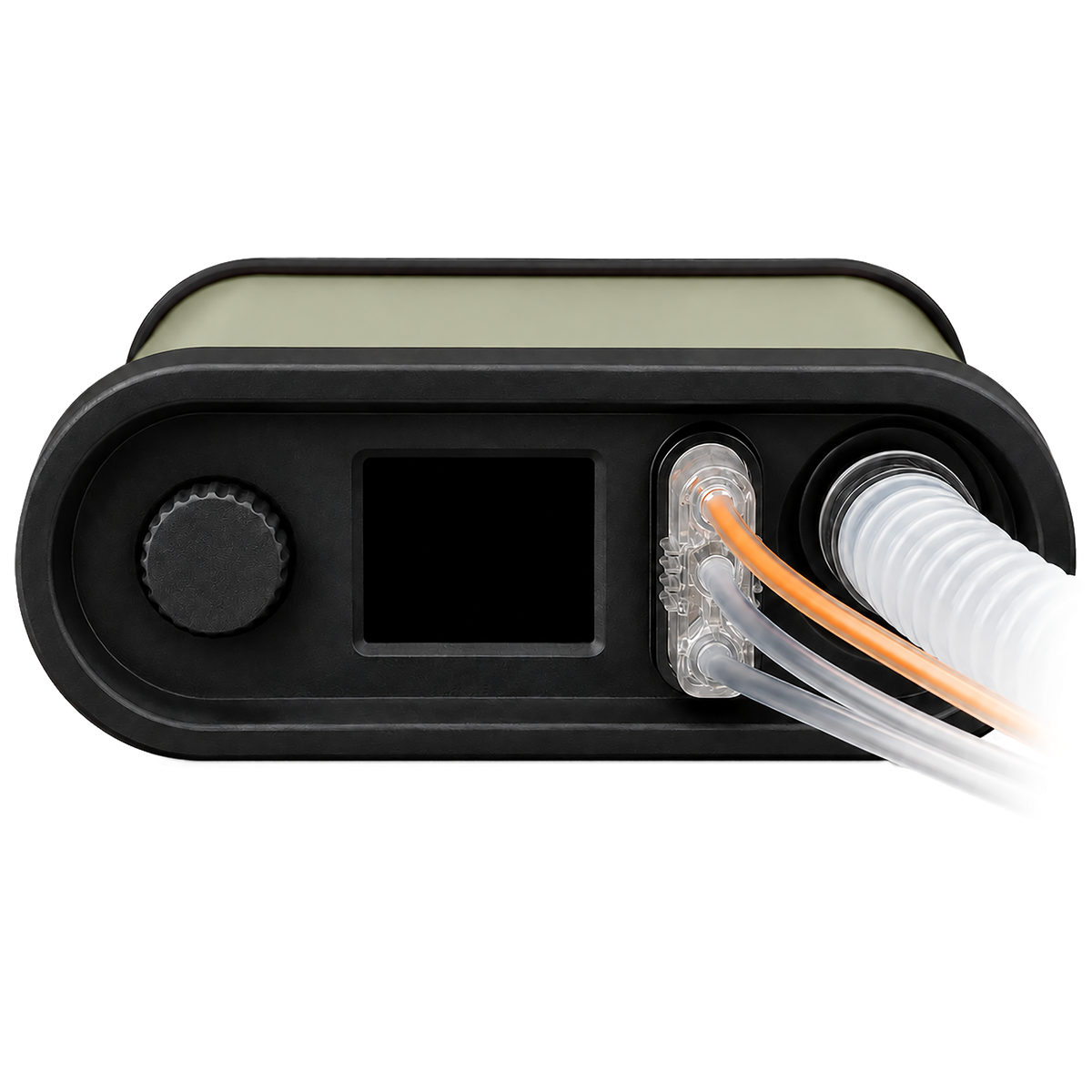
Ventway Sparrow Robust. Dial left, screen centre, patient circuit right
Screen brightness and night mode
On the panel, open MENU > ADV. SETTINGS > BRIGHTNESS and use the dial. This changes the device display independently of the wiki’s night control.
Panel level
Configured display output
Behavior
Panel level
1 / Night
Configured display output
5.5%
Behavior
Very dim without goggles. The configured output becomes 85% under image intensifiers.
Panel level
2
Configured display output
45%
Behavior
Reduced brightness
Panel level
3
Configured display output
72%
Behavior
Startup default
Panel level
4
Configured display output
100%
Behavior
Full brightness
In gameBrightness and alarm volume
These percentages are game display multipliers. Selecting night brightness also lowers alarm volume once; the volume can then be adjusted separately.
Panel icons
InventoryHow the unit reads in your kit. 22kg empty, 40kg with a battery
BootShown while it starts. Replays if the unit is moved or reloaded
AlarmOpens the alarm window. Carries the active count
SilencedAudible muted, the alarm itself is still active
GraphsPressure and flow traces
BreathOne breath at the current settings
MenuStop vent, new patient, adv. settings
ConfirmCommits the value under the dial
CancelDrops the edit and leaves the value alone
BackPrevious screen in the setup sequence
HomeStraight back to LIVE
NextAdvances once the current screen is satisfied
On batteryDraining. Fill shows what is left
PluggedOn vehicle power, drain stopped
ChargingRefilling. Full from empty in about 90 min